I was raised by people who linked food to athletic performance. Food wasn’t only for nourishment, pleasure, convening. It was a way to gain a competitive advantage. Imaginary and real competitors were poised at any moment to steal say, your World Record, or maybe just the sub 6 minute mile-time you got last weekend. Thus the debates about what to eat, when to eat, how much to eat were never ending.
Today, obsessing about food and exercise is no longer weird. But in the 80’s, having your Dad sneak creatine monohydrate in the pancake mix was almost as strange as living in a house that had squat racks, barbells and obscure Soviet-era exercise equipment in the basement.
I guess this backstory is my justification for feeling so strongly that “you are what you eat” is an apt metaphor for media, the thing I care about as much as my family cares about sport. “You are what you read, watch, listen to” is starting to make its way into the collective conversation, which I think is a good thing.
Now that we’re questioning the intentions and impact of the algorithms that “serve” (lol, trap) us, and starting to wonder about the provenance and quality of the content they’re serving us, I wonder where we will turn once we realize there’s a problem to solve, a habit to try to change. Who will we trust to help us stop smoking, or trade the Doritos for a more sensible pack of Late July Nacho Cheese chips (Yuka rating 85/100)? Who will we trust to program our VIP resource, time?
Sometimes I think it could be here, on Substack. It’s still human, communal, creator-friendly and therefore sustainable-ish. For now. For the people who can pay.
Other times I look for answers from the past. Because culture is cyclical. Because the imposed constraints of the physical medium necessitated quality, filtering, curation that we used to scoff at and call gatekeeping but we now need more than ever. Taste as identity (“100% slop-free, grass-fed social” 🔥), Curation as a Service (RIP), analog media and IRL “experiences”, private WhatsApp groups and the return to the greatest recommendation system of all time: word of mouth.
Maybe there is no media analog right now. Maybe, back to food, the thing we are waiting for is Whole Foods (quality, but expensive) meets Trader Joes (affordable, but is it actually good for you?). It’s a place that carries what you want, and surprises you with things you didn’t know you needed. A place where you know everything on the shelves is verified, sustainable, transparently labeled. A place that foregrounds human opinion (curation) and backgrounds the algorithms that here exist not to feed you, but to stock the shelves. Because ultimately, in this store, you choose what to buy and eat. You have agency over what you consume.
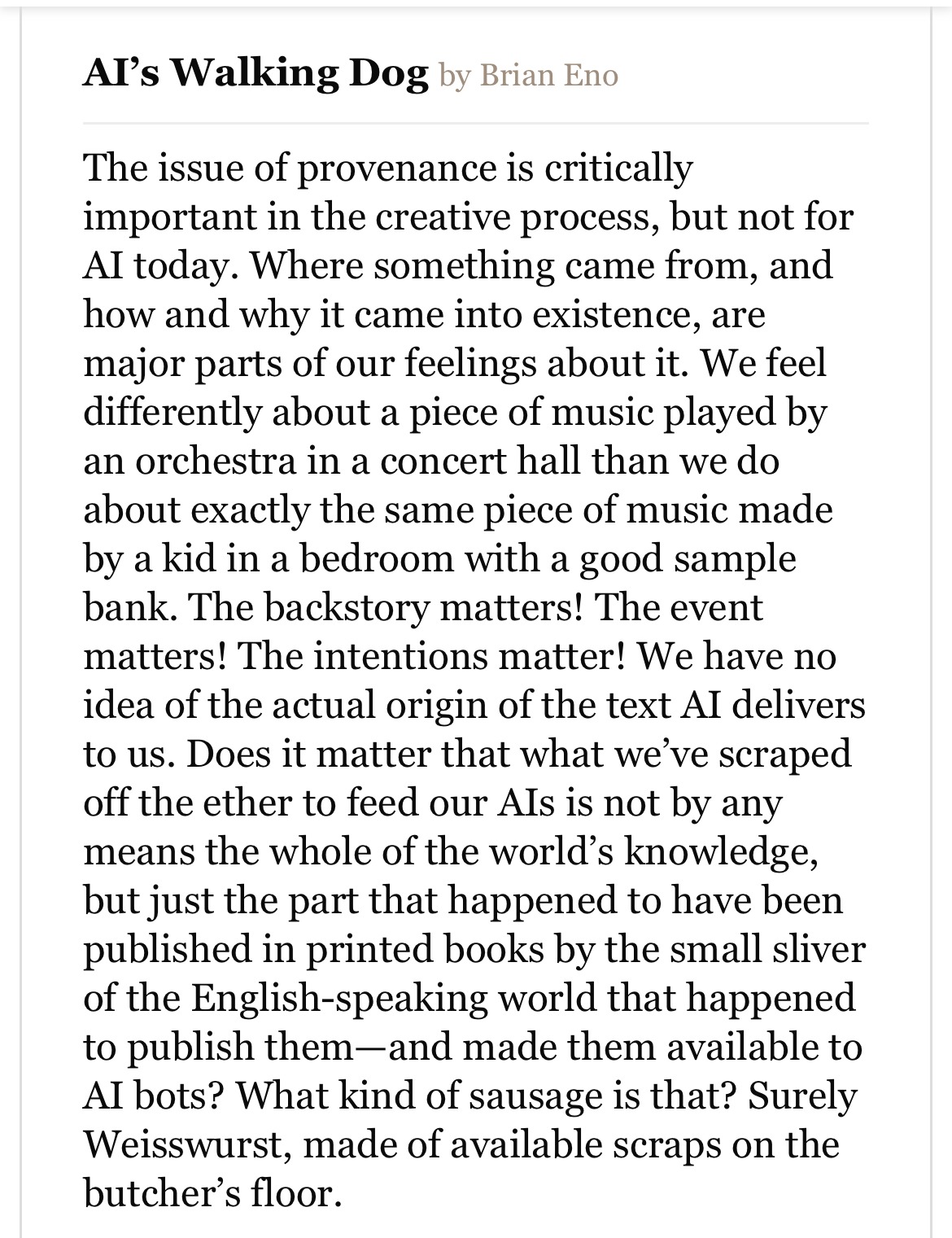
When I read Brian Eno’s article on this topic, I thought of my friend Cameron’s great project, Slash Purpose, which was an invitation to use your website’s about page to state your reason for being, your intention. Imagine if we knew not just the ingredients, but the backstory of what we are consuming. And imagine if we understood the intentions of who we’re trusting to feed us. Only then, I suppose, can we decide when we want Weisswurst or Niman Ranch.